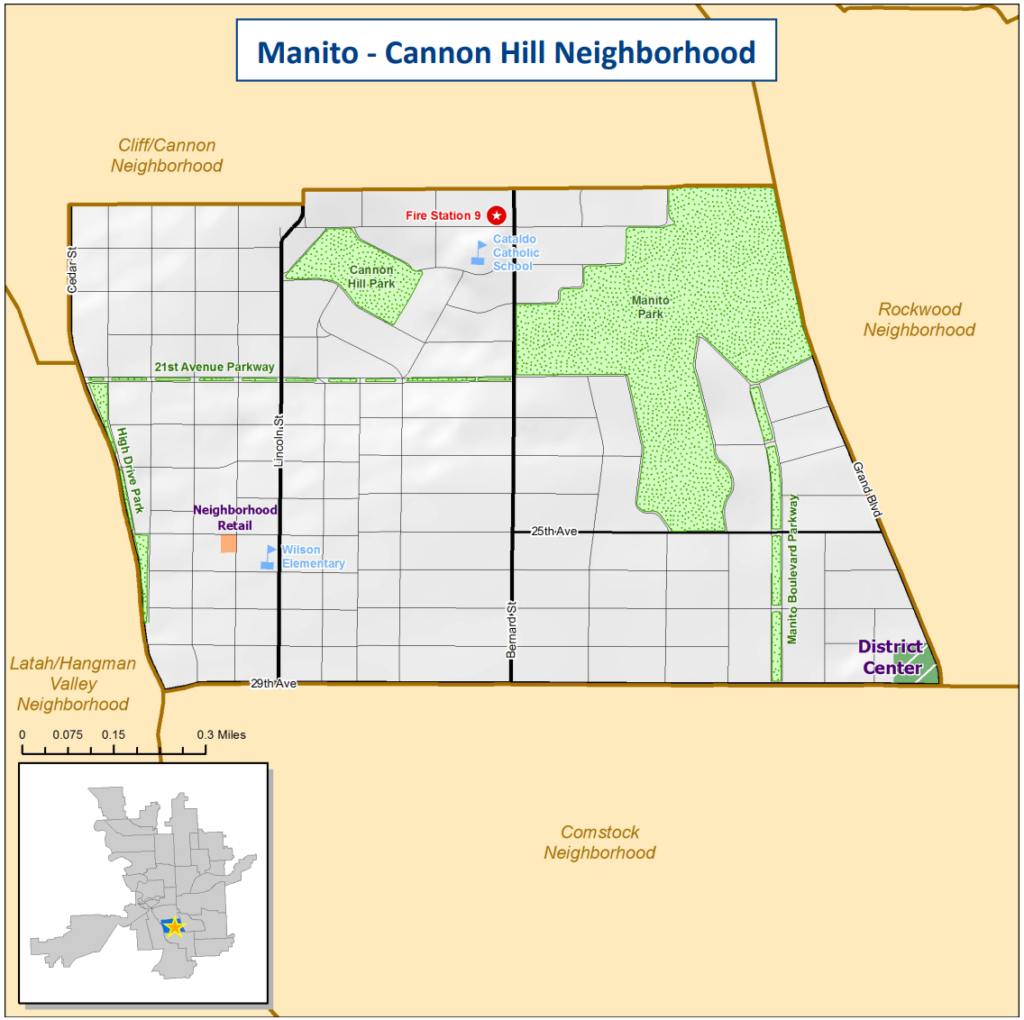
About Manito Cannon Hill Neighborhood
Catalysts for residential development in Manito/Cannon Hill included the streetcars (1888-1936), parks, boulevards, and Wilson Elementary.
In the 1880s, a clay deposit was discovered on the land that is now Cannon Hill Park. The clay was used for making bricks and the site became a brickyard. Once all of the clay was harvested, the brickyard was moved, making way for Cannon Hill Park amenities in later years.

Lilacs in Bloom (Wilma Flanagan)
The Olmsted brothers developed their design for Cannon Hill Park when they arrived in Spokane in 1907. The plans included a recommendation to replace the old brickyard with a park dedicated to “quiet recreation.” The design included a stone shelter, two pergolas, and a children’s wading pool. The wading pool was easy to construct as a depression left in the ground by the brickyard left a natural pool, shallow enough to play in to cool off in the summer and freeze for ice skating in the winter. The park was originally named Adams Park because the land was owned by John Quincy Adams’ grandson and was changed to Cannon Hill Park for A. M. Cannon, local banker and real estate developer.
The Olmsteds also outlined a vision for High Drive Parkway and Adams Boulevard (21st Avenue) for the purpose of “pleasure driving and walking” and to connect parks in their 1908 System of Parks and Parkways. In 1909, Adams Boulevard was developed as part of the Cannon Hill residential addition, and included some of the nicest homes in the city at that time.
Manito/Cannon Hill Neighborhood remains very vibrant today. We encourage you to get involved in your neighborhood! All residents, property owners, and business owners in Manito/Cannon Hill are encouraged to attend our general membership meetings!